Updated: 2025
What are reactors, and how do they work?
- Nuclear power reactors harness the energy released from fission (splitting atoms) to heat water and make steam, which is then passed through a turbine to generate electricity. Naval reactors use the same principles to employ fission energy for naval propulsion.
How a Reactor Works
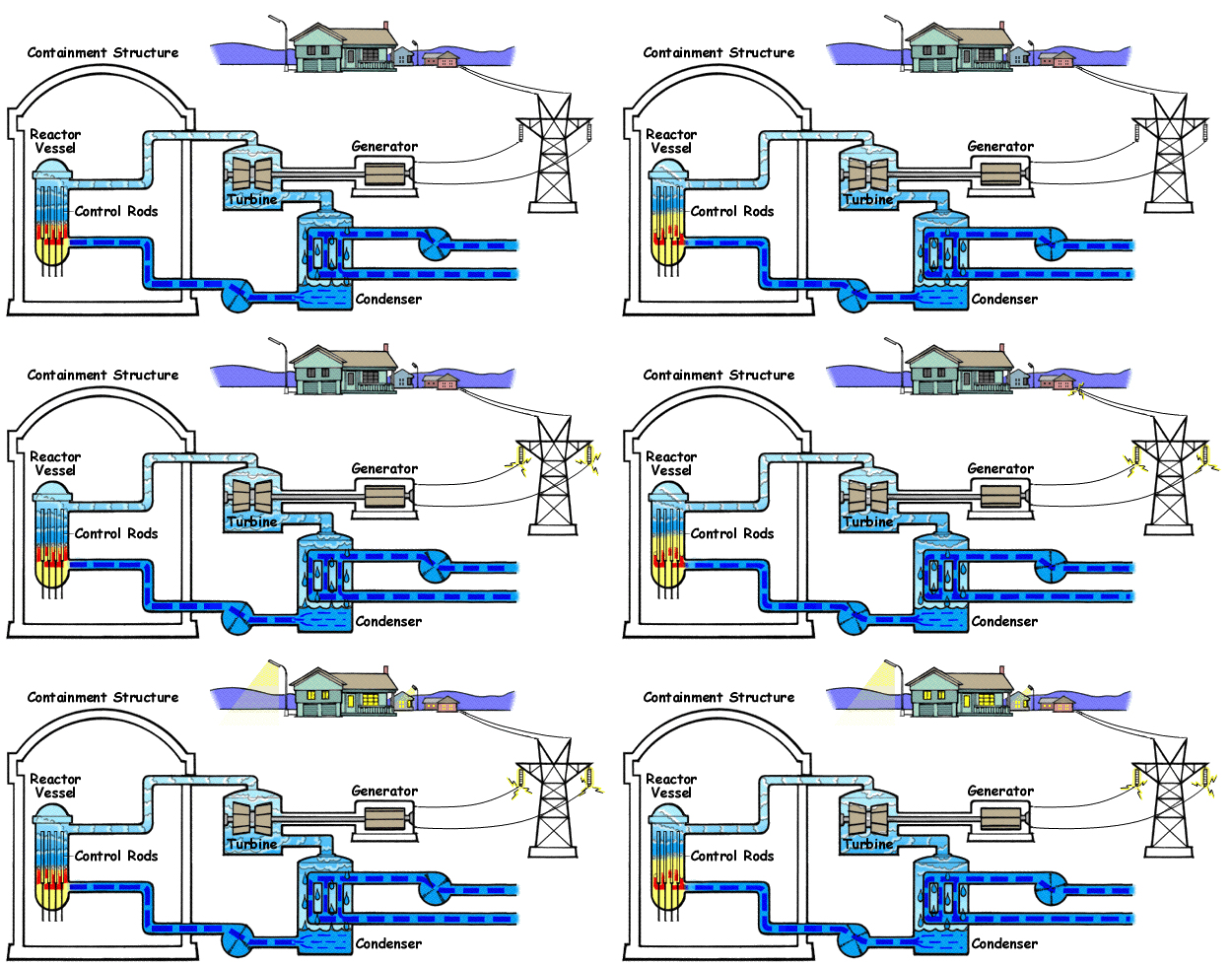 Animated Diagram of a Boiling Water Reactor, Source: U.S. Nuclear Regulatory Commission
- Instead of harvesting the energy produced from fission, research reactors use the steady flow of neutrons to produce other valuable materials for medical, scientific, agricultural, and industrial applications, or for university research and training. For example, some research reactors produce medical isotopes, also called radioisotopes, vital for cancer therapy and diagnostics. Radioisotopes are also used extensively in a variety of industries—from the automobile industry to construction and mining.
- Both nuclear weapons and nuclear reactors rely on fission chain reactions, discussed in module 1. In a nuclear weapon, a chain reaction is uncontrolled, growing as more and more atoms fission, and culminating in a nuclear explosion. In a reactor, the chain reaction is controlled (using what are known as control rods), so that on average only one of the two or three neutrons released from each fission causes an additional fission. This is called a sustained chain reaction since the rate of the reaction does not increase like it does in a nuclear weapon.
- In a reactor, the fast-moving neutrons produced by fission are more likely to go on to cause additional fissions in surrounding uranium-235 and plutonium-239 atoms if something is done to slow them down. This is why all nuclear reactors (except fast reactors), employ moderators, which are capable of slowing the neutrons down.
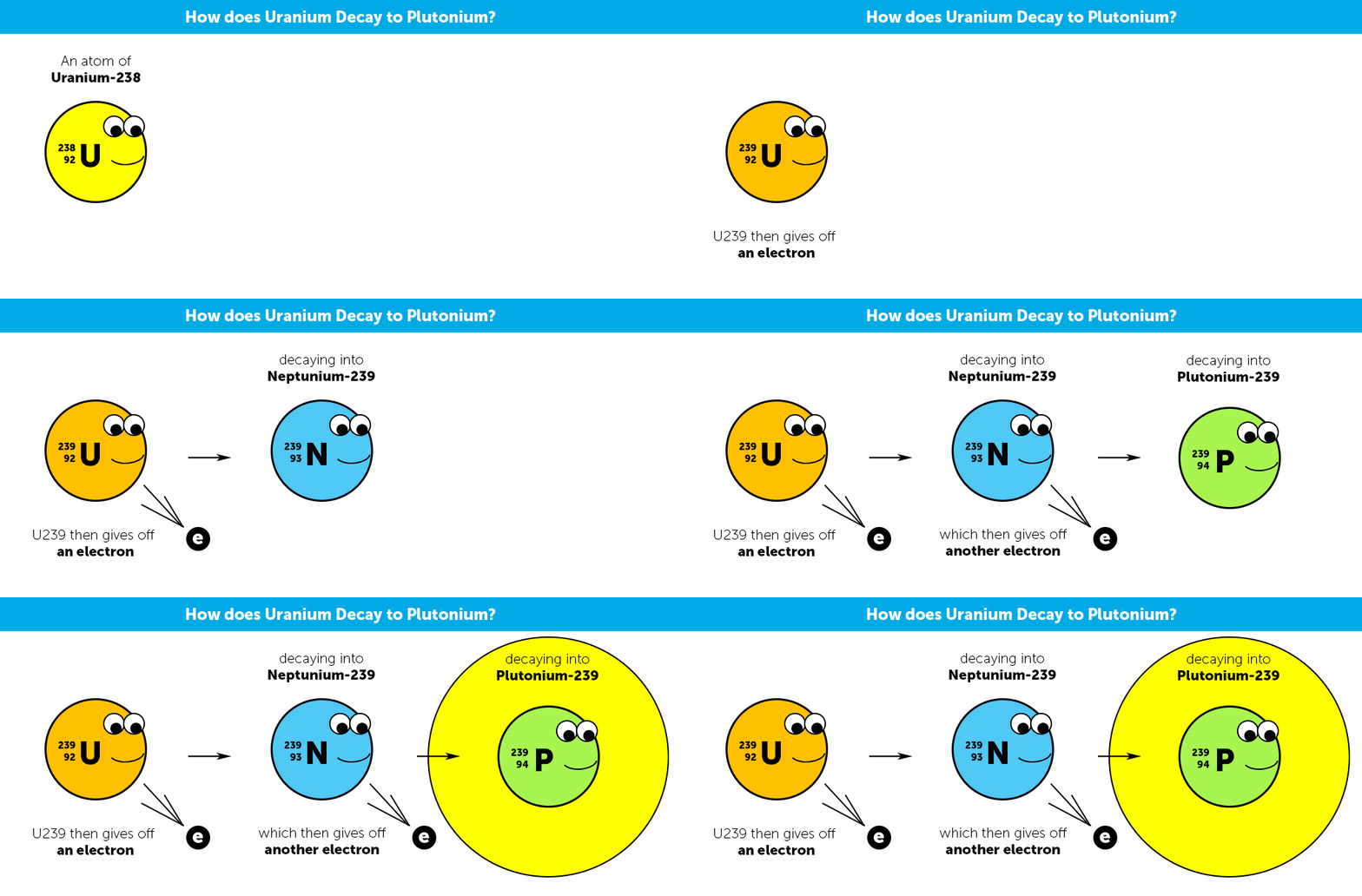
- All nuclear reactors produce plutonium in their spent (or used) fuel as a byproduct of reactor operations. Plutonium does not occur in nature, except in miniscule quantities. When fission occurs in a reactor, some of the neutrons produced cause fission in uranium-235 atoms, while others are captured by the uranium-238 atoms in the fuel. When a uranium-238 atom captures a neutron, it turns into uranium-239. Because uranium-239 is unstable, it soon radioactively decays (losing particles known as an electron and an anti-neutrino), to form neptunium-239, and then decays again to form plutonium-239.
Plutonium Production
Why do countries choose different types of reactors?
Nuclear Reactor Basics
Information
Power Reactors
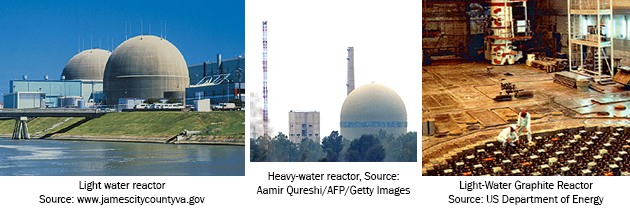
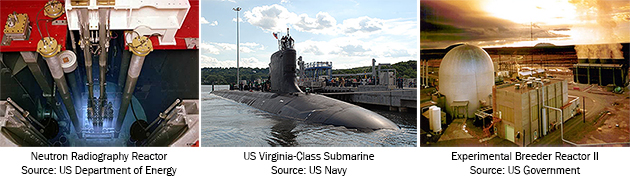
Other Reactors
Prevalence
Globally
Here is a global snapshot of the reactors in operation as of 2025: [1]
- 440 nuclear power reactors in 31 countries and Taiwan with a combined capacity of around 400 GWe. [2]
- 80% of all power reactors are LWRs
- 227 research reactors in operation, 7 in temporary shutdown, or 24 under construction or planned in 54 countries and Taiwan [3]
- Over 160 ships are powered by more than 200 nuclear reactors, operated by only 6 countries: China, India, France, Russia, the United Kingdom, and the United States. [4]
- China, India, Japan, and Russia have experimental and/or demonstration fast-reactors and 5 other countries historically operated fast reactors experimentally or for demonstration. [5] Only France ever operated a fast reactor commercially—the Superphenix—and it was shut down in 1998 following years of safety and other technical malfunctions.
Cost
Reactor costs include the costs of building and operating a reactor, the security costs of protecting the reactor from sabotage or theft, and the anticipated costs of managing the spent nuclear fuel, which may include interim storage as well as final repository costs. No country has yet opened a large-scale final repository. This is a qualitative assessment meant to show relative rather than absolute cost differences among general reactor types.
- Power reactors typically cost billions of dollars to construct, and require costly physical security and spent nuclear fuel management.
- Research reactors typically cost millions of dollars to construct, and expend less fuel and require less security than power reactors. However, for HEU-fueled research reactors, more costly security is required.
- Naval reactors are presumed to be very expensive, but the militaries that have them release very little information publically.
- Fast reactors remain experimental and are extremely expensive.
Theft Risk
This is the risk, qualitatively assessed, that non-state actors could steal the material and remove fuel from the facility. A low risk expresses that the fuel assemblies are too heavy and too highly irradiated so that the material affords some self-protection; stealing the material would be difficult and would cause bodily harm to the thieves.
- HEU fuel would be of interest to thieves whether it is fresh or has been run through the reactor and irradiated, though thieves might be deterred by the high radiation dose they would receive stealing irradiated fuel. Slightly enriched or natural uranium fuels would only be of interest for their plutonium content once irradiated.
- LWRs tend to have very highly irradiated fuel assemblies and are very large, so the risk of theft is relatively low.
- PHWR reactor fuel assemblies are smaller, and tend to be less radioactive and easier to steal. [8]
- Research reactors tend to have smaller fuel assemblies than LWRs, and since they are often implemented near academic institutions the security can be lower than at power reactor sites. Irradiated LEU research reactor fuel would be of interest for its plutonium, while both irradiated and fresh HEU research reactor fuel would be targets.
- While naval reactor fuel might be highly attracted to thieves, these types of reactors also generally have the highest levels of (military) security.
Proliferation Risk
The risk that uranium fresh fuel or plutonium in the spent fuel could be used by the non-nuclear weapon state (NNWS) on whose territory the reactor operates for a nuclear weapons program.
- All reactors pose some technical proliferation risk, but the degree varies according to the reactor design and fuel used.
- Aside from HEU-fuel, the materials in fresh and spent fuel are not directly weapons-usable without either enrichment or reprocessing capabilities. Both are limited to a small number of states, and are difficult for new states to acquire. Reprocessing is the easier technology for NNWS to pursue because the chemistry is widely known.
- A comprehensive assessment would go beyond reactor design into country-specific variables, which this chart does not do. These include questions like whether the country has any intent to develop nuclear weapons.
- The proliferation risks of any reactor are mitigated by International Atomic Energy Agency (IAEA) safeguards. NNWS in good standing with their commitments to the NPT subject their nuclear facilities to regular monitoring and verification by the IAEA, which accounts for nuclear materials and determines whether illicit diversion may have occurred. See NPT Tutorial
- Naval reactors are included in this assessment, because of their potentially high proliferation risks. Although no NNWS currently operate naval reactors, some are pursuing the technology. The NPT allows NNWS to exclude some of their HEU from IAEA safeguards monitoring if it is designated to become naval reactor fuel.
Uranium Risk
This is the proliferation risk posed by the reactor's fresh uranium fuel.
- The fuel used by power reactors and LEU-fueled research reactors would only be useful for nuclear weapons if further enriched. While few NNWS have enrichment capabilities, a state possessing them would be able to produce weapons-grade HEU more quickly and with less effort starting with 3-5% LEU rather than with natural uranium. For example, the amount of effort required to enrich natural uranium to weapons-grade HEU is 70% completed when the uranium reaches 4.5% LEU.
- Research reactors and naval reactors using HEU fuel pose a high proliferation risk. All HEU is technically weapons-usable, and in some cases, the reactors already use weapons-grade fuel. With further processing, such fuel could be used for nuclear weapons. As such, the United States and Russia have led global efforts to convert HEU-fueled research reactors to LEU fuel, and dozens of reactors have been converted to-date.
Plutonium
Produced
How much plutonium can be produced per year by each reactor type? The risk is numerically expressed as the number of 10,000-ton bombs that could be produced per year, assuming a country has reprocessing capabilities and each bomb requires 5 kg. plutonium. [7]
- PHWRs and LWGRs using natural uranium or slightly enriched uranium fuels, followed by research reactors using these fuels, pose the most serious plutonium-related proliferation risks. They produce high quantities and qualities of plutonium.
- Research reactors using low enriched uranium can produce hundreds of kilograms of plutonium in their spent fuel each year.
- HEU-fueled research and naval reactors pose low plutonium-related risks, as they produce relatively little plutonium in their spent fuel.
- Fast reactors use a mixture of plutonium and uranium as fuel. Depending on their design they can produce vast quantities of plutonium. For example, the new Indian fast breeder reactor is expected to be able to produce as much as 140 kg weapons-grade plutonium per year.
Plutonium
Quality
Like uranium, there are different isotopes, or types, of plutonium. The most desirable fissile isotope for nuclear weapons is plutonium-239. Unlike uranium, any quality of plutonium can be used in a nuclear weapon. However, it is easier to manufacture a bomb out of plutonium with higher percentages of the odd isotopes such as Plutonium-239. This attribute expresses the risk in terms of the percentage of odd isotope (plutonium-239 and plutonium-241) after one year of reactor operation. [6]
- LWRs pose relatively low proliferation risks. While they produce high quantities of plutonium, the quality is poor. States building first nuclear weapons might not risk working with this so-called "reactor grade plutonium," as it would be more difficult to build a bomb out of than high quality plutonium.
- The highest quality plutonium is produced in fuels made out natural or slightly enriched uranium. Power reactors and research reactors using these fuels pose the most serious plutonium proliferation risks, since they produce high quality plutonium. The CIRUS reactor, supplied by Canada to India was a heavy water reactor which India used to produce weapons-grade plutonium for its nuclear weapons program despite claiming the reactor was for peaceful purposes.
- Research reactors and naval reactors are generally fueled with uranium enriched to 19.75% or higher (some even use weapons-grade HEU), so only small amounts of lower quality plutonium are produced.
- Fast reactors vary in design and can produce weapons-grade plutonium or be modified to produce low quality plutonium.
How and why is plutonium separated from spent fuel?
- When plutonium is produced in a reactor, it is mixed in with a large number of other radioactive isotopes produced by the reactor. When removed from the reactor, the spent fuel is contaminated with a large variety of isotopes, rendering its plutonium content useless for weapons or nuclear fuel without significant additional work.
- Through a technique called reprocessing, spent fuel can be chemically treated to separate out the plutonium, making it available for use in reactor fuel or in a nuclear weapon.
- Reprocessing requires significant technical expertise and some specialized equipment, but is less technically challenging than uranium enrichment. Detailed information on the process and necessary equipment has been readily accessible in the open literature since it was first published by the U.S. government in the 1950s as part of efforts to share peaceful nuclear technology with other countries.
- The standard reprocessing method, known as PUREX (Plutonium Uranium Extraction), involves chopping the fuel rods into pieces and then dissolving them in a hot acid. A mixture of light chemicals is added to the acid, which preferentially separates highly radioactive waste from the plutonium and uranium components of the fuel. The lighter mixture of chemicals containing the plutonium and uranium components are easily extracted from the acid containing the waste because the chemical drifts on the acid like oil on water. Uranium is then separated from plutonium by similar means, and both products are extracted and turned into a powder.
- After it is separated, the plutonium can be combined with natural or low enriched uranium and fabricated into mixed oxide fuel (MOX) for use in certain types of reactors, or converted to a metal, machined, and used to build a nuclear weapon.
- 10 countries have known reprocessing capabilities (China, France, India, Israel, Japan, North Korea, Pakistan, Russia, the United Kingdom, and the United States). Japan is the only country without nuclear weapons with plans to reprocess spent fuel (as part of its nuclear power program). Reprocessing is highly controversial because of economic, environmental, and proliferation concerns.
- Commercial reprocessing was originally envisioned as a way to transition toward the use of fast breeder reactors, a special type of reactor with the potential to produce more plutonium than it consumes for a specified period.
- Breeder reactors and reprocessing facilities proved more costly than expected, and the global growth of nuclear power proceeded much more slowly than had been projected in the 1970s. Furthermore, huge discoveries of deposits of recoverable uranium ore in Australia and Canada dispelled concerns about future shortages of low-cost uranium.
- Separated plutonium presents significant proliferation and nuclear terrorism risks. The global stockpile of separated plutonium stands at about 560 metric tons, 420 of which were produced outside of weapons programs. [1]
Source: [1] Fissile Material Stocks, International Panel on Fissile Materials, April 13, 2024, https://fissilematerials.org.
Sources for: Why Do Countries Choose Different Types of Reactors
[1] Percentage of a particular type of reactors operating compared to all operating nuclear reactors (including power, research reactors, and naval propulsion reactors, excluding <1% gas cooled reactors).
[2] “Plans for New Reactors Worldwide,” World Nuclear Association, Updated May 2023,
https://world-nuclear.org/information-library/current-and-future-generation/plans-for-new-reactors-worldwide.aspx#:~:text=Today%20there%20are%20about%20440,10%25%20of%20the%20world's%20electricity..
[3] IAEA Research Reactor Database (RRDB) https://nucleus.iaea.org/rrdb/#/home.
[4] “Nuclear-Powered Ships,” World Nuclear Association, February 2023, https://world-nuclear.org/information-library/non-power-nuclear-applications/transport/nuclear-powered-ships.aspx.
[5] “Fast Neutron Reactors,” World Nuclear Association, August 2021,
https://world-nuclear.org/information-library/current-and-future-generation/fast-neutron-reactors.aspx
[6] This estimate does not include additional processing or optimization of plutonium production for each reactor type. The fast reactor assumed is the PFBR in India and data is taken from http://fissilematerials.org/library/rr08.pdf.
[7] While a 10 kt bomb could be built using less plutonium, the 5 kg assumption is based on the estimated capabilities of a new, relatively low-technical capability nuclear weapon state. Plutonium data from http://www5vip.inl.gov/technicalpublications/documents/5554578.pdf and 5 kg estimate for 10 kt bomb from https://www.nrdc.org/nuclear/fissionw/fissionweapons.pdf.
[8] C.W. Coates and B.L. Broadhead, “A Summary of Characteristics and Dose Levels for Representative Spent Reactor Fuels,” May 2007, Oak Ridge National Laboratory,
https://www.researchgate.net/publication/238613298_Characteristics_and_Dose_Levels_for_Spent_Reactor_Fuels.